I’ll never forget the morning a business owner called me, sounding genuinely shaken. He had done what every owner does when they want quick reassurance: searched his brand name on Google. Minutes earlier, his profile showed strong ratings and fresh feedback.
Now the review count looked lower, the latest comments were missing, and the public listing felt weaker overnight. No email. No warning. No timeline. Just a silent change that could easily cost him calls, foot traffic, and confidence. That moment taught me something I now repeat to every client: review visibility is not guaranteed, even when the reviews are real, well-written, and earned the right way.
The uncomfortable truth: reviews can exist but still not be visible
When business owners say, My reviews disappeared, they usually mean one of these scenarios:
- The review is delayed and not fully published yet
- The review is soft hidden (the reviewer can see it, but the public cannot)
- The review is filtered into a hidden section on certain platforms
- The review is removed due to policy enforcement
- The profile is temporarily restricted after suspicious activity patterns
Google openly confirms that reviews can be missing or delayed, and that removal often happens due to policy violations like spam or inappropriate content. They also warn that appeals can take longer during high-volume periods. (Google Help)
This matters because platforms do not treat reviews as “your property”. They treat reviews as user content that must remain trustworthy to protect the platform’s credibility.
Why this matters to business owners more than ever
Reviews are not decoration. They are conversion fuel. They influence:
- Clicks from local search
- Phone calls
- Direction requests
- Website visits
- Trust in your pricing and service quality
BrightLocal’s consumer research repeatedly shows that review behavior is now mainstream and consistent across industries, and their 2024 survey found that 88% of consumers would use a business that responds to both positive and negative reviews, compared to just 47% who would consider a business that never responds. (BrightLocal)
That stat alone tells you reviews are not passive content anymore. They are part of how customers judge your professionalism.
Now add this global reality: fake review manipulation has become a serious economic issue. TIME reported fake reviews can influence an estimated $152 billion in purchases annually, which is exactly why platforms are getting more aggressive with filtering. (TIME)
So when your honest reviews get caught in the crossfire, it feels unfair. But the platform is playing defense.
Step by step: the real reasons businesses lose review visibility without notice
Below is the diagnostic breakdown I use as a business and marketing specialist. If you understand these triggers, you’ll stop feeling blindsided and start managing reviews like an asset.
1) Automated spam filters suppress legitimate reviews quietly
This is the most common cause, and also the most frustrating. Google uses automated systems to scan contributions for suspicious signals, and policy-violating content may be removed automatically or flagged for more review by trained analysts. (Google Help)
In practice, this creates a weird reality: a review can be submitted successfully, but never become publicly visible.
What triggers suppression most often:
- The reviewer account is brand new or inactive
- The reviewer posts many reviews in a short time
- Too many reviews arrive on your business profile within hours
- Review wording feels repetitive across multiple customers
- Review includes promo-style language
- The review comes from a suspicious device pattern or location mismatch
Real example (common in clinics):
A clinic runs a WhatsApp or SMS review request campaign. Twenty patients review within two hours. The reviews are real, but the velocity looks unnatural. Google’s system may temporarily suppress part of that batch.
What owners usually do wrong:
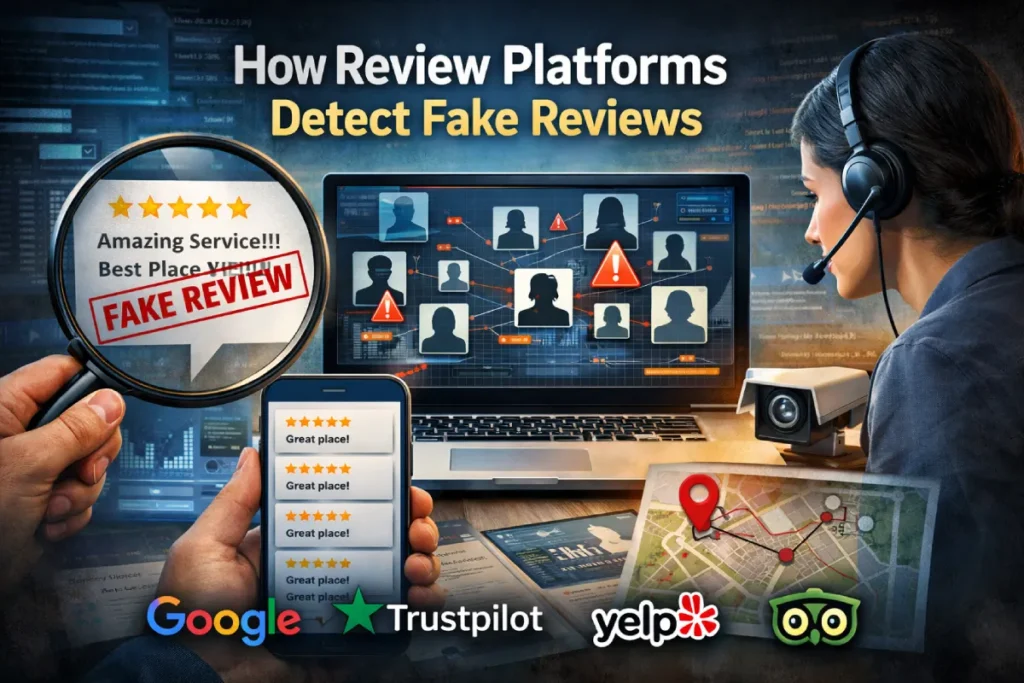
They panic and ask even more people to review immediately. That often increases suppression, not fixes it. You can also read a detailed guide on how review platforms detect Fake reviews on Google, Trustpilot, Yelp, and TripAdvisor.
2) Certain words and patterns trigger policy enforcement
Most owners assume policy violations only apply to obvious spam. Not true. Even normal people write things that accidentally trigger filters.
Google explicitly lists prohibited content categories such as obscenity and profanity, and removes content that violates policies. (Google Help)
So even if a review is praising you, it can still be removed or restricted if it contains risky elements like:
- Profanity used casually
- Personal data
- Phone numbers
- Aggressive accusations
- Hate or harassment language
- Explicit content
Example:
A happy customer writes: “They are the best, call them at 03XX…”
That can look like promotional content or lead generation behavior. Sometimes it passes. Sometimes it gets filtered.
3) Review platforms tightened enforcement and will not always warn you
This is not paranoia. It’s documented enforcement escalation.
Google has intensified action against fake review practices. The Verge reported that businesses violating fake engagement policies can face penalties including temporary removal of reviews, blocks on new reviews, and warning messages. (The Verge)
That means your listing can be affected even if you did not knowingly break a rule, because the system reacts to patterns.
On top of that, the UK Competition and Markets Authority announced undertakings from Google requiring sanctions for businesses that boost ratings with fake reviews, plus warning alerts and punishments for repeat offenders. (GOV.UK)
Even if you are not in the UK, this is a global signal: platforms are being pressured to enforce harder.
4) Yelp and similar platforms filter reviews into hidden sections
This is where many businesses lose visibility without realizing it.
Yelp openly explains that some reviews are not recommended for multiple reasons, including that they may be posted by a less active user or seem unhelpful. (Yelp for Business)
So the review exists, but sits in a section most people never click.
Independent analysis also suggests Yelp can filter a notable portion of reviews, with some sources citing roughly 25% being not recommended by the algorithm. (Nowspeed)
Example (local services):
A customer creates a Yelp account for the first time just to support you. Yelp sees a low activity profile and pushes the review into not recommended. The customer thinks they helped. You never see the benefit.
5) Major Google Business Profile edits can trigger trust recalibration
I’ve seen this happen more times than I can count.
These edits can increase risk scoring:
- Changing your business name
- Switching primary category
- Editing the address or service area
- Changing phone number or website
- Frequent hour edits
- Repeated keyword stuffing attempts
When a profile becomes “unstable”, systems often tighten moderation. It’s not personal. It’s platform security behavior.
Practical lesson:
Do not treat your profile like a social media bio you update every few days. Treat it like a legal listing. Stable details win.
6) Competitor pressure and mass reporting can accelerate suppression
Not every review issue is purely automated fairness. In some industries, competitors do play dirty:
- Mass reporting your reviews
- Reporting your profile edits
- Suggesting your business is closed
- Triggering disputes repeatedly
Platforms will usually decide with automated checks first, not human investigation. That means visibility can drop quickly while the system “evaluates”. This is one reason I recommend owners document review milestones with screenshots monthly, so you have evidence if escalation is needed.
7) The reviewer’s account got restricted, deleted, or cleaned up
This is a blind spot that confuses owners.
If the reviewer:
- Deletes the review
- Deletes their account
- Gets suspended for unrelated behavior
Then your review disappears too.
So your business can lose reviews without any action from you. That’s why relying on only a few high-value reviews is risky. You need a steady base.
8) Travel and marketplace platforms remove content at scale
If you are in hospitality, travel, rentals, or tours, this is critical.
TripAdvisor’s content moderation transparency reporting states that in 2020, more than two million review submissions, representing 8.6% of all submissions, were rejected or removed. (Tripadvisor)
That figure is huge. It proves a key point: moderation is not rare. It is continuous.
So if your reviews vanish on travel platforms, it may not be a targeted action. It may be part of constant filtering.
9) Indexing delays and sync differences create “ghost review” experiences
Sometimes the issue is not removal. It is delay and inconsistency.
Google itself acknowledges “missing or delayed reviews” and indicates some disappearances are related to policy checks or processing delays. (Google Help)
What I check when diagnosing delay issues:
- Google Search listing vs Google Maps listing
- Logged out view vs logged in view
- Desktop vs mobile
- Different networks (WiFi vs mobile data)
- Incognito results
- Time window of 48 to 72 hours
A review that looks missing might simply be “pending trust validation”.
Why platforms act this way in the first place
I always explain this to owners using a simple model:
A review platform survives on consumer trust, not business happiness.
If customers believe reviews are fake, the platform loses authority, and customers stop using it.
Google even publishes a transparency report showing enforcement numbers for reviews, photos, edits, and more, blocked or removed due to policy violations. (Google Transparency Report)
That alone tells you how serious the scale of moderation is.
And because fake reviews have become a massive industry, platforms now punish patterns, not just obvious offenders.
The hidden “review trust score” concept most owners ignore
Most platforms won’t call it a trust score, but functionally it behaves like one.
I think of it as a dynamic reputation risk profile influenced by:
- Reviewer credibility
- Review velocity
- Content uniqueness
- Business listing stability
- Industry spam risk
- Prior violations in the category
- Regional abuse patterns
This is why two businesses can run the same review request campaign and get different outcomes.
One stays visible.
One gets filtered.
Because the system considers the full context.
The business damage of losing review visibility
If your reviews drop publicly, you can see:
- Fewer calls from local search
- Lower map pack engagement
- Reduced click-through rate
- More price resistance from customers
- Higher churn due to trust gaps
BrightLocal’s 2025 survey also highlights that many consumers use more than one platform, but a growing share rely on just one site, which increases risk for businesses dependent on a single ecosystem. (BrightLocal)
If your main platform visibility drops, you can lose the consumer who never checks alternatives.
Pros and cons of aggressive review filtering
Pros
- Reduces fake review manipulation
- Protects consumer trust over time
- Prevents large-scale review bombing in many cases
- Pushes businesses toward genuine customer experience improvements
Cons
- Real reviews get suppressed without transparency
- Smaller businesses suffer more because every review matters
- Support paths can be slow during heavy volume periods (Google Help)
- Some industries become “high-risk zones” where visibility is harder to maintain
The warning signs your business is losing review visibility
Here are the patterns I tell business owners to track weekly:
- Review count drops suddenly
- Rating shifts without new negative reviews
- Customers say they reviewed you but nothing shows publicly
- Your latest reviews are invisible for days
- A campaign causes a spike, then silence, then missing reviews
- You see reviews in one view but not another
If two or more happen in the same month, treat it as a reputation event, not a minor glitch.
Solutions: how to protect review visibility long term
This section is the playbook I’d give any serious business owner. It reduces suppression risk and builds long term resilience.
1) Maintain steady review velocity like a heartbeat
Platforms trust consistency more than spikes.
Healthy pattern:
A few reviews every week, depending on your business size.
Risky pattern:
Thirty reviews in a single day, then nothing for three weeks.
Tip:
Train staff to request reviews gradually after genuine wins. Not in one big blast.
2) Stop scripting what customers should write
Scripted reviews create repetition, and repetition triggers filters.
Avoid telling customers to write:
- “Fast service, great price, best in town”
Because dozens of people repeating that becomes a pattern.
Instead ask:
“Can you share what stood out most in your experience?”
Natural wording creates natural diversity.
3) Never incentivize public reviews
Even “small incentives” can trigger platform suspicion and policy risk.
Avoid:
- Discounts for reviews
- Gift cards for reviews
- Entry into contests for reviews
If you want incentives, reward private feedback surveys instead, not public ratings.
4) Keep your Google Business Profile stable
Avoid frequent major edits. If you must edit, do it in planned batches.
For example:
- Update hours and photos this week
- Update services next month
- Avoid changing name, category plus phone in one week
Stability reduces risk.
5) Respond to reviews like a real person
BrightLocal’s research shows review responses shape trust strongly, with 88% of consumers preferring businesses that respond to both positive and negative reviews. (BrightLocal)
Even if response behavior is not always a direct ranking factor, it is a powerful conversion factor.
Response timing strategy:
- Positive reviews: within 7 days
- Negative reviews: within 24 to 48 hours
Tone rule:
Human. Specific. Calm. No copy-paste templates.
6) Build a weekly review audit routine
This takes 10 minutes, but it saves months of confusion.
Track:
- Total review count
- Average rating
- Last 10 review dates
- New review visibility status
- Any customer complaints about missing reviews
Also, take a screenshot at the end of each month for your records.
7) Use the clean escalation path when reviews vanish
Here is the step-by-step sequence I follow:
- Confirm visibility in incognito and on another device
- Ask the reviewer if they still see it on their profile
- Check for policy trigger words (links, numbers, profanity) (Google Help)
- Wait 48 to 72 hours if it looks like a delay scenario (Google Help)
- Use Google’s official missing or delayed review guidance and appeal process (Google Help)
- Avoid duplicate appeals because Google warns that duplicates slow processing (Google Help)
8) Diversify your review ecosystem
I do not like single platform dependency. It is risky.
BrightLocal’s 2025 survey notes most consumers use two or more sources, but behavior is shifting year to year. (BrightLocal)
So build trust across:
- Yelp (if relevant to your category) (Yelp for Business)
- TripAdvisor (travel and hospitality) (TripAdvisor)
- Industry platforms (healthcare, legal, home services)
The goal is simple: if one platform glitches or suppresses, you still have proof elsewhere.
9) Build “review proof” into your customer journey
This is a smart marketing shortcut.
Add review collection naturally into:
- Post purchase SMS flow
- Thank you email sequence
- Invoice footer message
- QR code at checkout
- Follow-up call after service completion
But keep it spaced out. Always.
10) Protect yourself from third-party review scams
If someone emails you saying:
“We can remove bad reviews” or “We can guarantee reviews show”
Be careful. Many of these operations create spam patterns that can put your listing at risk.
Remember: Google and regulators are enforcing harder now. (GOV.UK)
If a vendor promises shortcuts, you might pay twice. Once in money, and again in visibility loss.
The “Review Visibility Checklist” I recommend
Use this weekly:
- Keep review requests consistent
- Avoid review wording scripts
- Do not incentivize public reviews
- Respond to reviews calmly and specifically
- Limit major profile edits
- Track review count and rating weekly
- Diversify platforms for safety
- Document review milestones monthly
Common business owner questions and practical answers
Q1) Why can I see the review but customers cannot?
Because it may be soft hidden, delayed, or filtered by automated systems that scan for suspicious signals. (Google Help)
Q2) Should I ask customers to repost missing reviews?
Yes, but only after confirming it is truly missing publicly. If the same customer reposts immediately with similar wording, it can trigger suppression again.
Q3) Can competitors remove my reviews?
They can attempt mass reporting. The platform decides. The bigger risk is that your profile becomes “high sensitivity” and future reviews get filtered more often.
Q4) Why does Yelp hide some reviews even when they are real?
Yelp may not recommend reviews from less active users or reviews that seem unhelpful. It is part of their recommendation system. (Yelp for Business)
Q5) Are platforms removing more reviews now than before?
Yes, enforcement and public warnings are expanding as platforms increase fake review crackdowns and regulators demand action. (The Verge)
My final advice as a business and marketing specialist
If you run a business, you need to treat reviews like a living performance channel. Not a trophy wall.
Platforms are protecting trust, fighting fraud, and policing patterns at scale. TripAdvisor’s transparency reporting alone shows millions of submissions removed or rejected in a single year, proving this is constant moderation, not rare cleanup. (Tripadvisor)
So here’s the winning strategy:
- Earn reviews steadily
- Keep listing stability high
- Avoid spikes and scripts
- Respond like a human
- Track changes weekly
- Build proof across multiple platforms
That is how you keep review visibility from disappearing without notice.