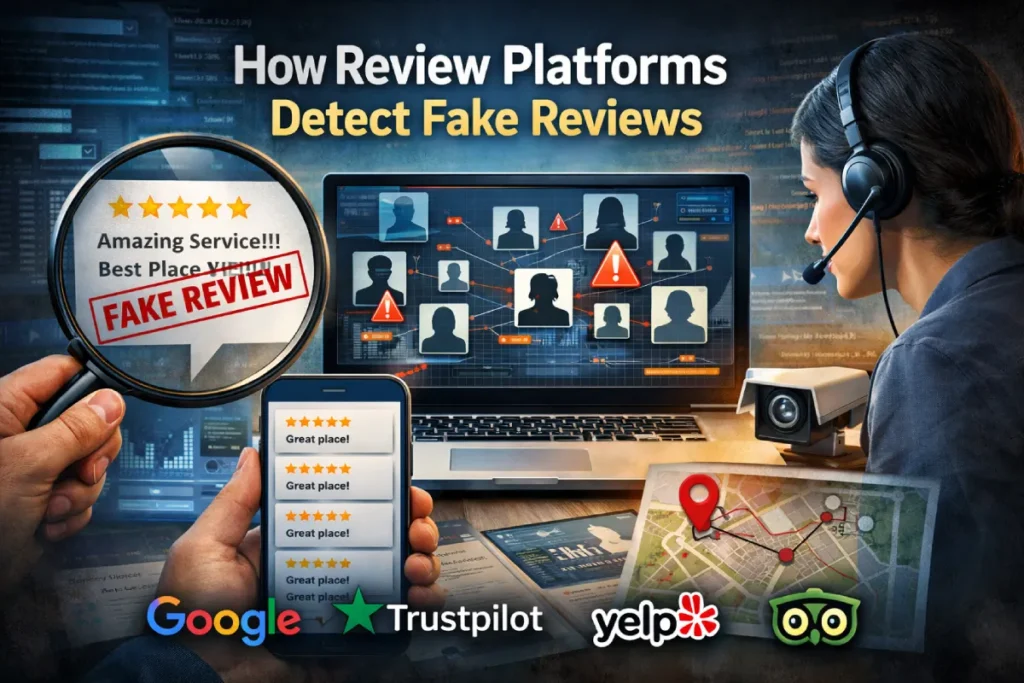
Honestly speaking, business owners usually think fake reviews are only a problem for other people. Then one day, they see a bunch of real reviews vanish, or a competitor sits at the top with ratings that feel impossible. You won’t believe what I’ve seen in audits. A business does everything right, yet the platform’s system quietly says no.
To be fair, these platforms are not judging your intentions. They are judging patterns. They use machine learning, network signals, and human investigations to protect their trust. Let me break it down step by step, in plain language, with practical examples you can actually use. If I’m honest, once you understand how detection works, your review strategy becomes calmer, safer, and way more effective.
Why platforms are so aggressive about fake reviews
Review platforms are trusted businesses. If shoppers stop believing reviews, the platform’s product collapses.
That is why enforcement is massive in scale.
- Google said it blocked or removed over 170 million policy violating reviews in 2023, plus blocked or removed more than 12 million fake business profiles. (blog.google)
- Trustpilot reported removing 3.3 million fake reviews in 2023, and noted most were caught by automated technology. (Trustpilot)
- Trustpilot later reported 4.5 million fake reviews removed in 2024, which it said was 7.4% of submitted reviews. (Trustpilot)
- TripAdvisor reported removing or rejecting more than 2.7 million fraudulent reviews in 2024. (PhocusWire)
Now, this is interesting. Those numbers are not just PR. They show you the mindset. The default posture is suspicion until patterns look normal.
Step 1: They judge the reviewer before they judge the review
What platforms try to verify first
The first filter is not what the review says. It’s who is saying it and whether the behavior looks human.
Platforms look at signals like:
- Account age and history
- Review frequency and bursts
- Whether the reviewer only reviews one brand ever
- Location consistency
- Device consistency
- Whether the reviewer’s activity matches normal customer behavior
You might find this interesting. A brand-new account writing a perfect five-star review can be treated as a higher risk than a three-star review from an active profile that has reviewed other places.
Example, you can picture
Imagine a new customer creates an account today, then posts 6 reviews within 10 minutes, all five stars, all short, all generic.
Even if those were real, the platform’s model sees:
- New identity
- Burst behavior
- Low detail language
- Abnormal speed
That combination screams automation or a paid review farm.
One thing I learned is this. Most removed reviews are not removed because of one signal. It is the stack of signals.
Step 2: They analyze language like a fingerprint
What language patterns trigger suspicion
Platforms run large scale text analysis. They look for:
- Repeated phrases across many reviews
- Overly promotional tone
- Unnatural structure, like the same sentence length every time
- Excessive brand keywords stuffed in
- Extreme sentiment with no context
- Reviews that read like ads
If I’m honest, the biggest mistake I see is businesses giving customers a script. The intention is good, but the effect is disastrous.
Good vs risky language example
Risky:
- Best service ever, highly recommended, five stars, amazing team
Trusted:
- I went on Tuesday around 3pm. They explained the pricing before starting. The job took 30 minutes and the result matched what they promised.
The second version contains a real-world context. It feels like a memory, not a marketing line.
Quick shortcut for business owners
Tell customers this instead of giving a template:
- Mention what you bought
- Mention when you visited
- Mention one specific detail
- Mention what you liked and what surprised you
That creates natural variety. Variety is safety.
Step 3: They track timing and velocity like fraud analysts
Review velocity is a major detection layer
Let me tell you, velocity is one of the fastest ways to get filtered.
If a business gets:
- 3 reviews per month for 2 years
Then suddenly: - 40 reviews in 3 days
That spike might be real, but the platform will treat it like a risk event.
Google, Trustpilot, Yelp, and Tripadvisor all treat sudden surges as suspicious because review farms operate in surges.
Example scenario
A restaurant runs a promotion, gets a rush of customers, and asks everyone to leave a review the same night.
It sounds logical. But the system may see:
- Same date cluster
- Similar wording because customers were prompted similarly
- Similar device and network patterns from people sitting in the same venue
What we experienced is that those “campaign nights” often lead to a wave of reviews getting delayed or hidden.
Safer alternative
Spread asks over time:
- Ask at the point of delight
- Follow up 2 to 3 days later
- Avoid one single blast
To sum it up, platforms are like a steady heartbeat, not a sudden explosion.
Step 4: They use location, device, and network signals
Device fingerprinting and IP clustering
You won’t believe how often this happens.
A business owner or staff member “helps” customers by letting them use the store’s iPad to write reviews.
From the platform’s view:
- Multiple accounts
- Same device fingerprint
- Same IP address
- Same geolocation
- Repeated behavior pattern
That is a classic fraud signature.
Even if each review is honest, the system cannot trust the pattern.
Practical rule
Never let multiple customers post reviews from:
- Your business WiFi
- Your staff phone
- Your shop tablet
- A shared kiosk
It’s worth mentioning. This rule alone saves a lot of businesses from random review removals.
Step 5: They compare review behavior to real-world business signals
Platforms look for mismatches.
Examples:
- A hotel gets lots of reviews, but little booking activity signals
- A brand gets reviews from faraway users who never show normal travel patterns
- A local business gets reviews from accounts that do not appear local at all
TripAdvisor especially cares about travel realism. It has publicly discussed fighting fraudulent reviews at high scale, including rejecting or removing millions yearly. (PhocusWire)
When the platform’s model cannot connect reviews to likely customer behavior, it tightens the filter.
Step 6: Reporting systems and human moderators kick in
Automation does not work alone
Automation catches most suspicious activity, but human teams still matter.
Trustpilot’s transparency reporting highlights that its automated detection identifies a large share of fake reviews. (Trustpilot)
TripAdvisor’s reporting and media coverage point to enforcement that includes a deeper investigation beyond simple automation. (PhocusWire)
Google’s Maps content systems also emphasize machine learning improvements and large-scale enforcement. (blog.google)
If I’m honest, once a listing is “on watch,” everything gets stricter. Past patterns influence future scrutiny.
How Google detects fake reviews
Google operates at an insane scale. That’s why it leans heavily on machine learning.
Google stated it blocked or removed over 170 million policy violating reviews in 2023. (blog.google)
What Google is especially sensitive to
Review spam patterns
- Bursts after inactivity
- Repetitive text across multiple listings
- Suspicious reviewer networks
Business Profile abuse
Google also said it removed or blocked more than 12 million fake business profiles in 2023. (blog.google)
That matters because fake review activity often ties to fake profiles and listing hijacks.
Helpful example
If ten reviewers leave five-star reviews for:
- Your business
- Plus 20 other unrelated businesses
all within one day, from accounts with minimal history
Google may treat that as coordinated spam and remove the whole batch.
Practical tip for owners
Build a review flow that does not create spikes:
- A slow and consistent request system
- Reply to reviews regularly
- Avoid “review parties” and incentives
How Trustpilot detects fake reviews
Trustpilot is stricter than many people assume because it sits in industries that attract fraud.
Trustpilot said it removed 3.3 million fake reviews in 2023. (Trustpilot)
It also said it removed 4.5 million fake reviews in 2024, representing 7.4% of submitted reviews. (Trustpilot)
What Trustpilot watches closely
Review source patterns
- Invitation flows
- Repeated sources that look automated
- Suspicious timing from “campaigns”
Reviewer behavior
- New accounts that only review one company
- Clusters from the same region that do not match the business customer base
Example that gets businesses in trouble
A company sends review links into a private group, and many people copy the same phrases.
Even if those customers exist, the platform sees coordinated language and coordinated timing.
Safer approach
Encourage original writing:
- Ask customers to mention the exact product
- Ask what problem it solved
- Ask what they would improve
That produces natural diversity.
How Yelp detects fake reviews
Yelp is famous for filtering. They do not always remove. Sometimes they mark reviews as not recommended.
Academic analysis has noted Yelp filtering rates around 25% in Yelp’s own reporting context, and studies have observed meaningful filtering shares in certain categories. (First Monday)
To be fair, that means genuine reviews can get filtered too.
What Yelp’s system tends to prefer
- Reviewers with history
- Local behavior consistency
- Reviews that read like real experiences, not praise slogans
Example
A first-time Yelp account writes:
- Amazing place, best service ever
That often gets filtered.
An active Yelp reviewer writes:
- Came here after work, waited 15 minutes, staff explained options, price felt fair
That usually survives.
Yelp owner shortcut
Instead of pushing for Yelp reviews hard, focus on:
- Getting real customers to become active reviewers over time
- Encouraging detail and context
- Avoiding any incentive language
How TripAdvisor detects fake reviews
TripAdvisor faces huge fraud pressure because travel reviews influence bookings directly.
TripAdvisor rejected or removed more than 2.7 million fraudulent reviews in 2024, according to industry coverage. (PhocusWire)
What TripAdvisor cares about
- Visit plausibility
- Reviewer travel patterns
- Suspicious review brokers and paid review networks
Example scenario
A hotel receives reviews from accounts that:
- Have no other travel reviews
- Posts from unrelated countries
- Submit reviews in bursts
TripAdvisor will often hold or reject these because they do not match traveler behavior.
Practical advice for hotels and tours
Ask for reviews after the stay in a natural window:
- 1 to 3 days after checkout
- Include a simple link
- Do not use heavy prompting text
That timing fits real memory behavior.
A step-by-step checklist to keep your real reviews safe
Let me break it down into steps you can implement this week.
Step 1: Stop scripting
Do not give customers a pre-written paragraph.
Instead, give prompts:
- What did you buy
- When did you visit
- One detail you noticed
- Did it match expectations
Step 2: Avoid spikes
Set a daily or weekly cap on review requests.
A steady pace looks real.
Step 3: Don’t use business WiFi for reviews
This is a big one. No shared devices.
Step 4: Train staff on what not to say
Never say:
- We will give you a discount for a review
- Please leave five stars
- We will reward you if you post
Even if your intention is harmless, the platform can treat it as incentivized.
Step 5: Respond consistently
Reply to reviews regularly.
Not all at once.
Consistency signals legitimacy.
Pros and cons of strict fake review detection
Pros
- Protects customer trust
- Reduces fraud and competitor sabotage
- Makes honest brands more competitive long-term
Cons
- Genuine reviews can be delayed or filtered
- Small businesses may feel powerless
- Appeals can be slow and unclear
To be fair, no detection system is perfect. But it is improving fast, and the direction is toward stricter enforcement, not looser.
Common myths business owners still believe
Myth 1: Only negative reviews get checked
No. Positive reviews often get stricter scrutiny because fake activity usually aims to inflate ratings.
Myth 2: A VPN solves it
Not really. Behavior patterns still show coordination.
Myth 3: More reviews fast is always good
Sometimes it’s the opposite. A burst can trigger filtering that reduces visible reviews.
Myth 4: If reviews disappear, the platform is biased
Sometimes yes, sometimes no. Most of the time it is pattern-based automation reacting to signals, not personal bias.
FAQ: Questions I get from business owners
Why do real reviews disappear on Google or Trustpilot?
Most often, it is timing spikes, shared network patterns, or reviewer credibility signals. Google and Trustpilot both enforce at massive scale, and both report removing huge numbers of policy-violating or fake reviews each year. (blog.google)
What should I do when reviews get filtered on Yelp?
Focus on building long-term reviewer credibility. Encourage detailed, contextual reviews and avoid any campaign-like behavior. Yelp filtering can impact a meaningful share of reviews. (First Monday)
Is it safe to ask customers for reviews?
Yes. Asking is normal. Incentivizing or scripting is what creates risk.
How long does trust recovery take after a flagged period?
If the business stops risky patterns, it can improve in weeks. If the business has repeated flags, it can take months for the system to trust new activity.
Can competitors fake reviews against me?
Yes, it happens. The best defense is:
- Steady, authentic review flow
- Consistent responses
- Collecting evidence and reporting clear violations
Final thoughts
If I’m honest, fake review detection is not magic, it’s pattern recognition at scale. The platforms are not asking you to be perfect. They are asking you to look real over time.
Looking back now, the businesses that win are the ones that stop chasing quick stars and start building repeatable trust systems.
And guess what. When your review growth looks natural, your rankings and conversions usually follow. Thanks for reading, and to sum it up, your best strategy is boring consistency. It works like a GOAT play in marketing, not flashy, just reliable.